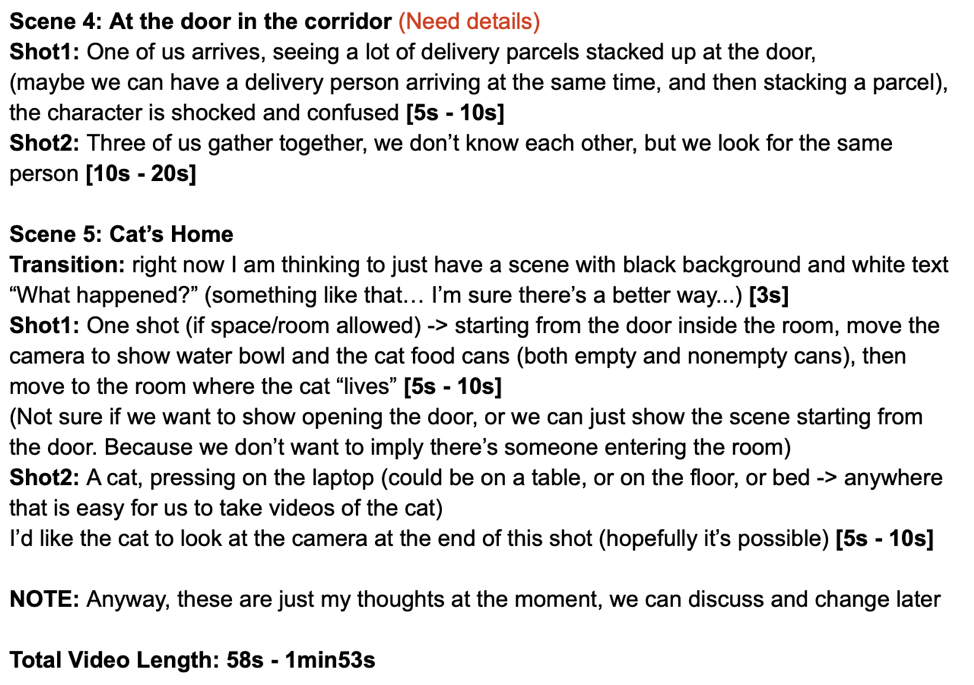
During our first group meeting, we discussed the narrative that we wanted to show in the video. While we were discussing, I felt there was already a video playing in my mind. I typed out a storyboard immediately after the day we finished writing the proposal. The attached screenshot shows the last two scenes of the storyboard.
Basically, a storyboard is like a flow diagram that illustrates the construction of the video shot by shot. It includes the details for each shot in regard to the camera angle and motion, narrative in the shot, duration, description of emotion of the characters and so on. Surprisingly, I have included every component of a storyboard we needed in my first draft of the storyboard without knowing the precise definition of a storyboard. To be honest, watching a variety of videos in my spare time seems very helpful in this video creation process.
When editing the video, I realized that the storyboard is the guide to follow in order to show the whole story, but editing needs some creative thinking as well as trial and error. For example, the speed and the duration of each shot have a significant impact on keeping viewers’ attention. We recorded the shot of Jiaqi knocking at the door for about one minute. Even though we intended to show that she has been knocking at the door for a long time, it feels lengthy to include this original recording in the final cut. Another example is that the choice of music and transitions between shots further keep the viewers’ interest. I used arpeggio to direct the viewer into the truth behind the story, and the last few musical notes work perfectly with a ripple transition into the next shot.
Written by Yili Wang
 AIYou's Digital Lives Video